
Two laboratories can test soil from the same location and obtain different CBR results.
The material may be similar. The testing machine may be working correctly. And yet, the final values may not be identical.
Why?
Because a California Bearing Ratio (CBR) test is not simply a matter of placing soil under a press and applying a load.
Before penetration begins, the material has been selected and prepared, placed into a mould, compacted and brought to the condition required by the applicable test procedure. During the test, penetration and load must be controlled and measured. Afterwards, the resulting data must be interpreted according to the method being followed.
Each of these stages forms part of the result.
For geotechnical professionals, this is familiar territory. But for anyone outside a materials laboratory, CBR also provides an interesting glimpse into something that usually remains invisible: the amount of testing behind the ground and materials on which our roads are built.
A CBR Test Is a Process, Not Just a Penetration Test
It is tempting to associate the CBR test with its most visible piece of equipment: the testing machine.
But the press only performs one part of a longer sequence.
A simplified way of looking at the process is:
Material → Specimen preparation → Mould and accessories → Compaction → Moisture and conditioning → Controlled penetration → Load-penetration data → CBR result
The exact procedure, equipment configuration and specimen condition depend on the applicable standard, project specification and purpose of the test.
That distinction is important. CBR testing is used internationally, and different standards and specifications do not necessarily prescribe every stage in exactly the same way.
What they share is a fundamental principle: the final value only has meaning when the conditions under which it was obtained are known and controlled.
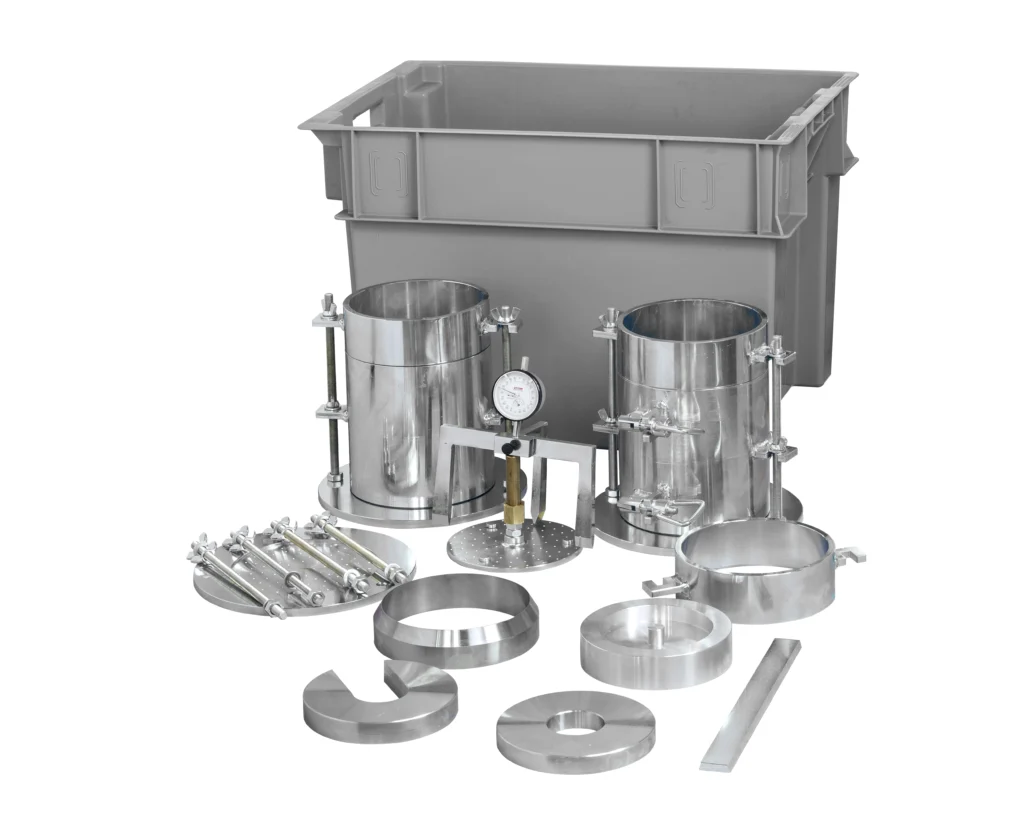
Before measuring how a soil responds to penetration, the laboratory has to create a specimen that represents the condition it intends to evaluate.
This may sound obvious, but it is one of the reasons why CBR should be understood as a process rather than as a single measurement.
The material must be prepared according to the applicable procedure. Moisture has to be controlled. The specimen must be formed inside a suitable mould and compacted under defined conditions.
The mould is therefore much more than a container.
Its dimensions, the accessories used with it and the way the specimen is prepared establish the physical conditions in which the material will later be tested.
This is also why apparently similar CBR equipment can have different moulds and accessories depending on the test method being followed.
For the laboratory, knowing which procedure is being reproduced is just as important as having a machine capable of measuring the final penetration.
Soil is particularly sensitive to water.
Unlike a manufactured material with relatively stable properties, the behaviour of a soil can change considerably depending on its moisture condition, density, structure and composition.
This is one of the reasons specimen preparation matters so much.
Water can affect the interaction between particles and therefore influence the response observed during penetration. Different soils react differently: a granular material and a fine-grained soil, for example, may respond very differently to changes in moisture.
The objective is not to assume that there is one universally correct moisture condition for every CBR test.
The important point is that the condition of the specimen is part of the test definition.
A CBR result therefore needs context. A number on its own tells us less than a number accompanied by an understanding of how the specimen was prepared and under what conditions it was tested.
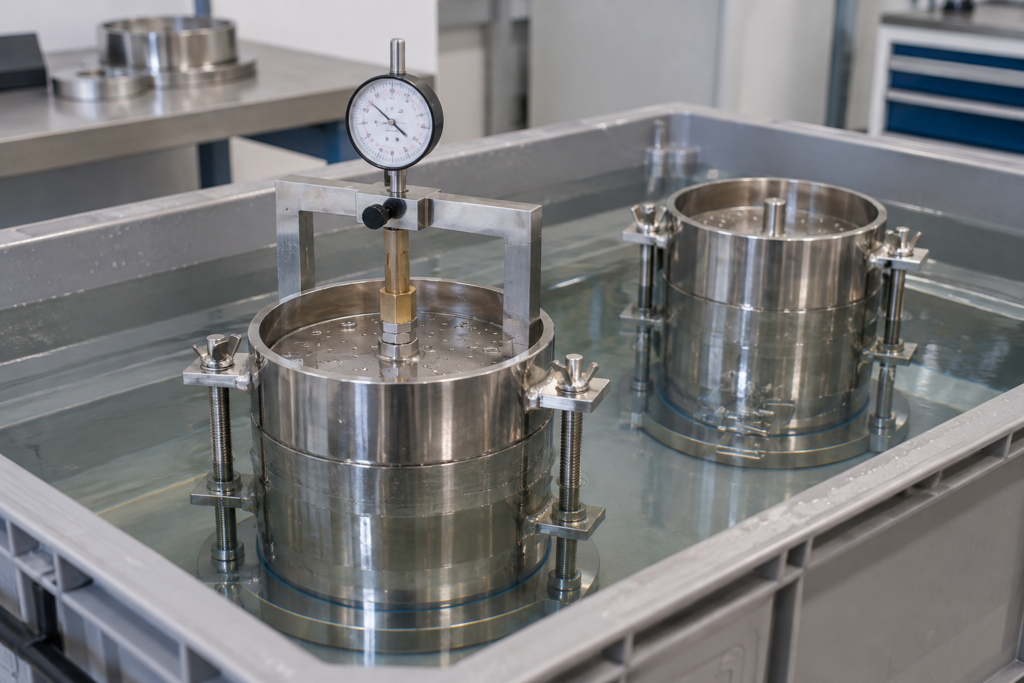
Depending on the applicable procedure and the information required from the test, a CBR specimen may be tested under a specified moisture condition or subjected to a defined conditioning process before penetration.
One possible procedure involves soaking the specimen.
Why would a laboratory deliberately expose a soil specimen to water before testing it?
Because engineers may need to understand how the material behaves under a moisture condition different from that in which it was initially prepared.
For certain procedures, changes in specimen height can also be monitored during conditioning. A perforated plate, stem and measuring device can be used to observe vertical movement of the specimen, providing additional information about its response to water.
The important concept is not that every CBR test must follow the same conditioning sequence.
It is that what happens to the specimen before penetration can affect the condition being characterized by the test.
Only after all these previous stages does the specimen reach the testing machine.
And this is where the CBR test becomes particularly easy to understand, even without a geotechnical background.
The objective is not to load the soil until it breaks.
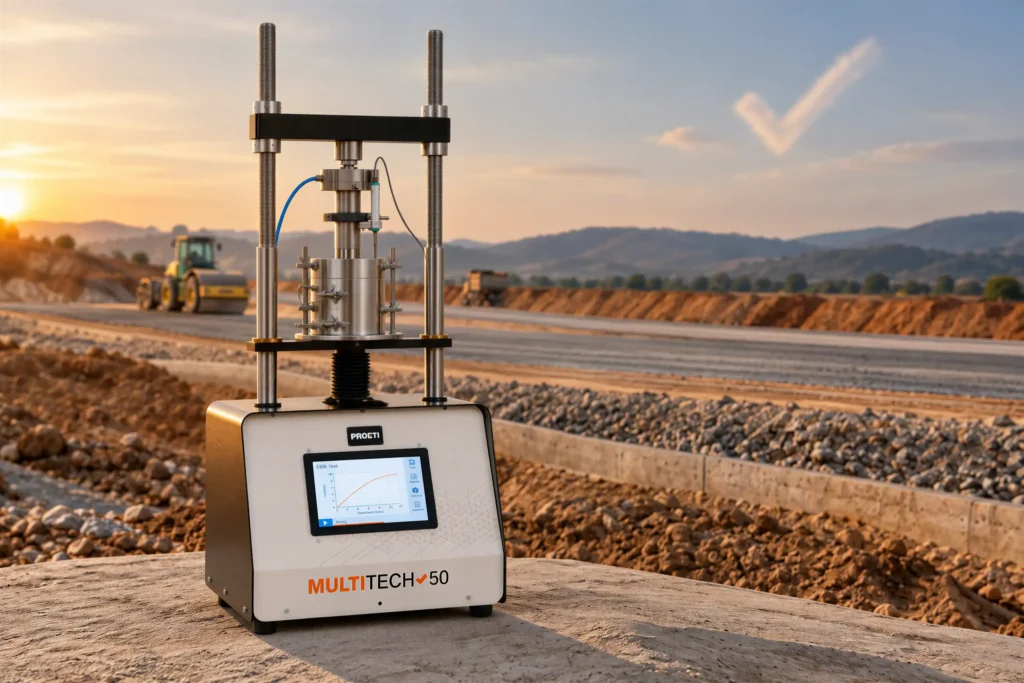
Instead, a cylindrical piston penetrates the prepared specimen at a controlled rate while the testing system continuously measures the resistance offered by the material.
In simple terms, the question is:
How much resistance does this material offer as we progressively penetrate it?
The result is therefore built from the relationship between load and penetration.
This requires the testing system to control movement accurately while measuring the corresponding load and displacement. The mould must remain correctly positioned, the piston aligned with the specimen and the acquisition system capable of recording the response throughout the test.
A relatively small movement of a piston through a laboratory specimen generates the information from which the CBR value will later be determined.
During penetration, the machine records a sequence of measurements.
As penetration increases, the resistance offered by the specimen changes. Plotting these measurements produces a load-penetration curve.
That curve is important because the CBR result is not simply the maximum force reached during the test.
The measured response at specified penetration points is evaluated according to the applicable procedure and compared with the reference values defined by that method.
This is what transforms the measurements made by the machine into a CBR value.
Again, the precise calculation and reporting requirements depend on the standard or specification being followed.
This is why it is preferable to think of CBR not as a universal number produced automatically by a press, but as a result obtained under a defined set of test conditions.
Real tests do not always produce perfectly shaped curves from the first instant of penetration.
Initial surface irregularities, seating of the piston or other aspects of the specimen/test arrangement can influence the first portion of the load-penetration response.
Applicable procedures may therefore define how certain initial irregularities are treated before the CBR value is calculated.
This may seem like a minor detail, but it illustrates an important principle of materials testing:
recording data and interpreting data are not the same thing.
A testing machine can measure load and displacement with great precision, but those measurements still have to be evaluated within the methodology that gives them engineering meaning.
The quality of the final result therefore depends on both sides of the process: reliable measurement and correct procedure.
We can now return to the question at the beginning.
If two laboratories test material from the same location, why might their results differ?
There does not have to be a single explanation.
Differences may arise from the material itself, specimen preparation, moisture condition, compaction, conditioning, equipment configuration, execution of the penetration stage or treatment of the resulting data.
Not every difference necessarily indicates an error.
Soils are naturally variable materials, and different standards or project specifications may also require different test conditions.
The relevant question is therefore not simply:
“Did both laboratories obtain the same number?”
A more useful question is:
“Under what conditions was each number obtained?”
That is what makes traceability, defined procedures and suitable testing equipment so important in a geotechnical laboratory.
Perhaps the most interesting part of the CBR test is the difference in scale.
In the laboratory, everything happens inside a relatively small cylindrical mould.
Outside the laboratory, engineers are dealing with roads, earthworks and pavement structures extending for kilometres.
Yet the connection between those two scales is fundamental.
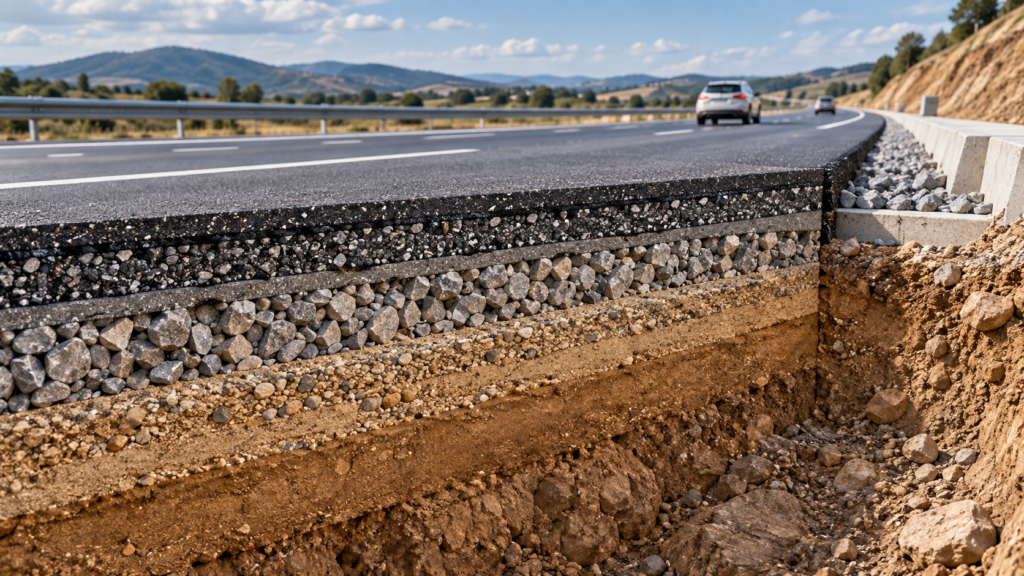
A road is much more than the asphalt surface visible to a driver.
Beneath it are different materials and layers, supported ultimately by the underlying ground. Their characteristics form part of the information engineers consider when specifying materials, assessing support conditions and designing or verifying pavement solutions according to the methodology applicable to each project.
CBR testing is one of the methods that can be used to characterize soils and pavement materials for these purposes.
It does not, by itself, design a road.
But it provides information about material behaviour that can contribute to broader engineering decisions.
The Number at the End Depends on the Process Before It
CBR testing is often summarized by a single value.
But that number is actually the final expression of a much longer sequence:
prepare, condition, penetrate, measure and interpret.
The testing machine is essential because it must reproduce the penetration stage accurately and record the material’s response reliably.
But the machine cannot compensate for a specimen prepared under the wrong conditions, an unsuitable configuration or a procedure that has not been correctly followed.
That is perhaps the most useful way to understand the CBR test:
the press measures the response of the specimen, but the complete procedure gives that measurement its meaning.
At PROETI, we design and supply equipment for the different stages involved in soil testing, including CBR moulds and accessories, specimen preparation equipment and testing systems such as the MULTITECH 50, designed to perform controlled mechanical tests and acquire the data required by the applicable procedure.
Because reliable materials testing is not about obtaining a number.
It is about knowing exactly how that number was obtained.