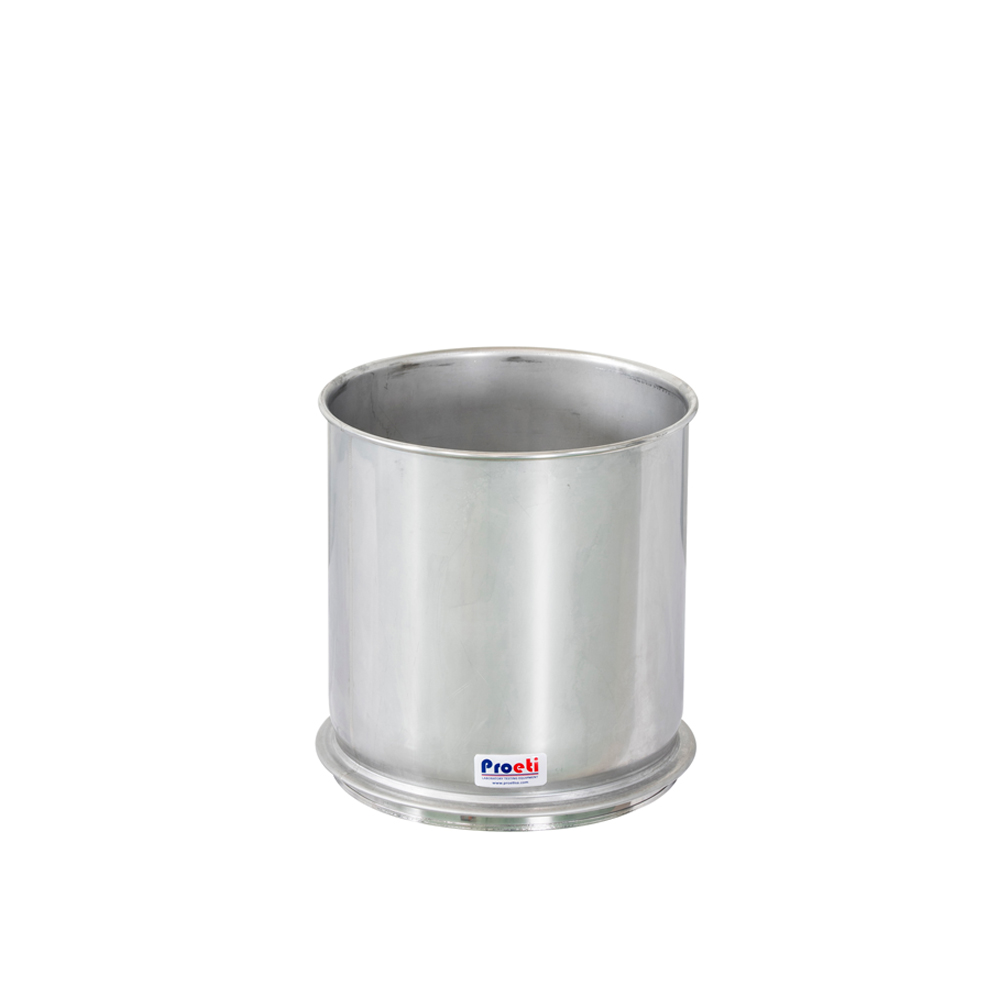
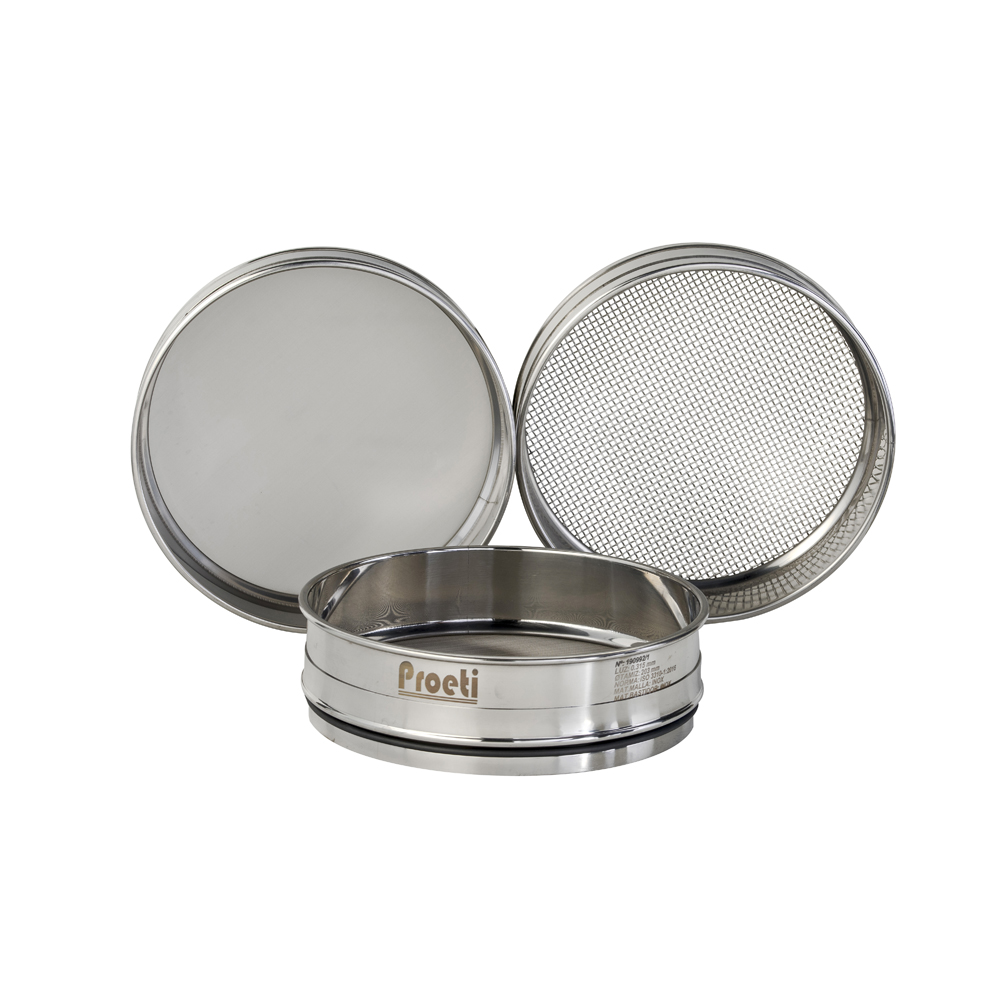
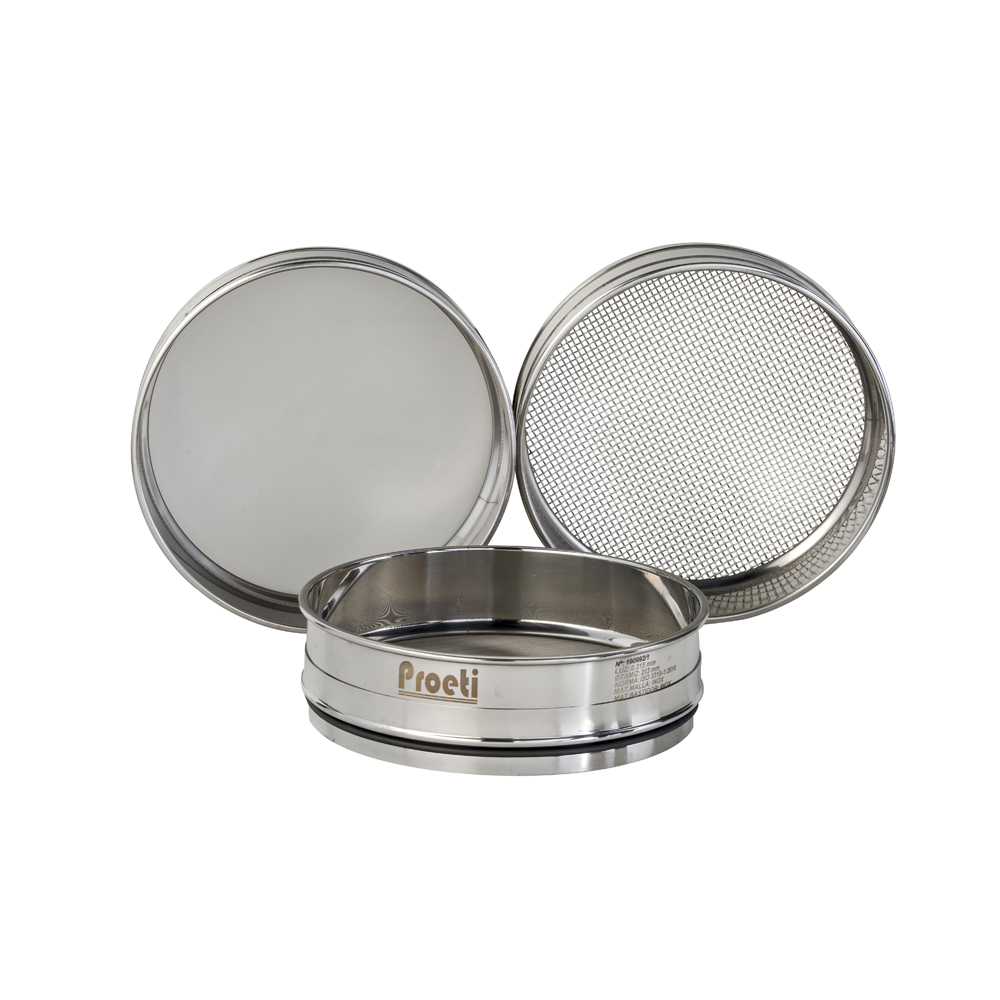
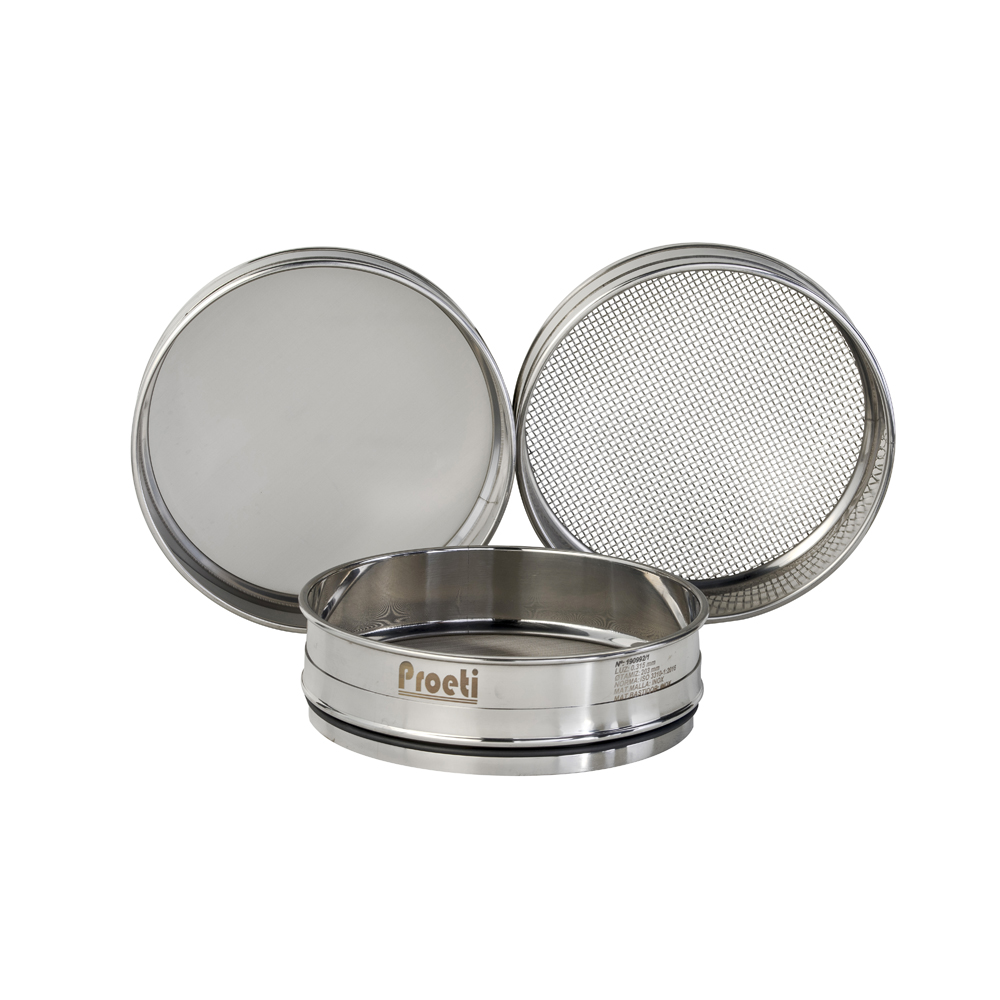
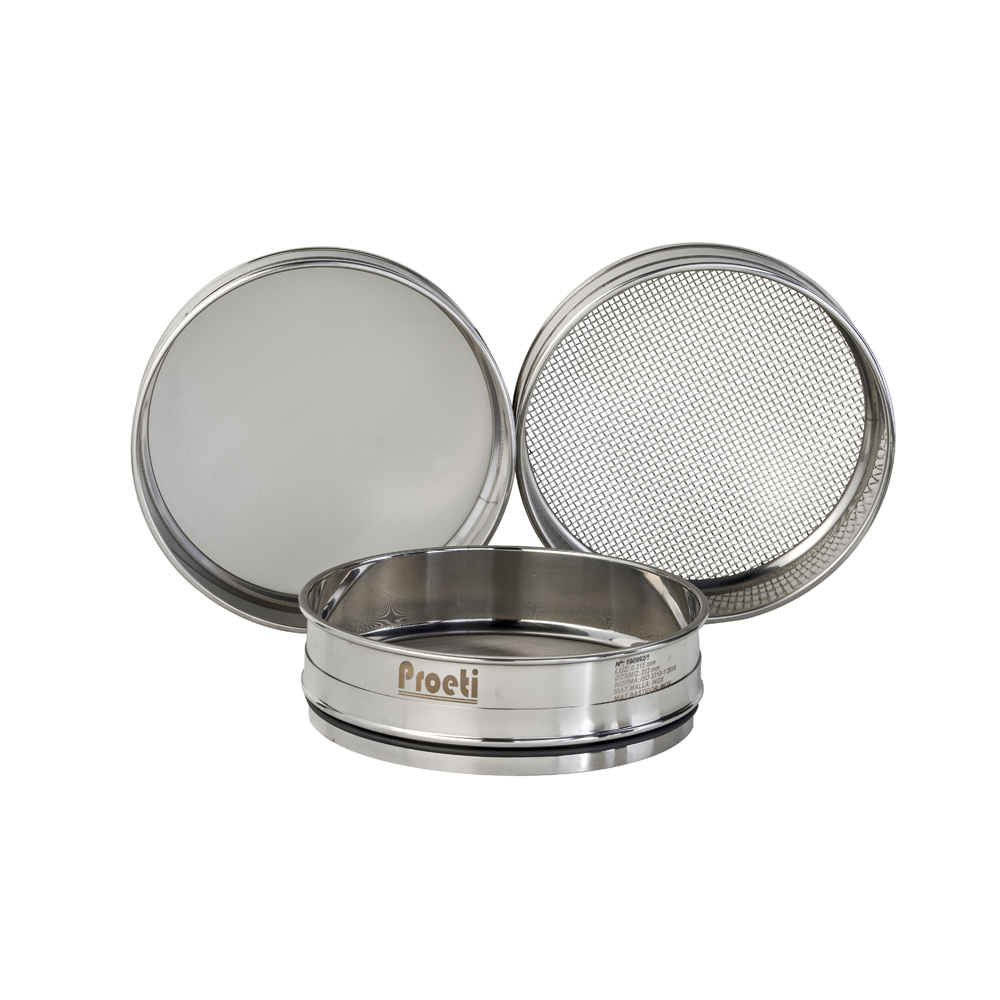
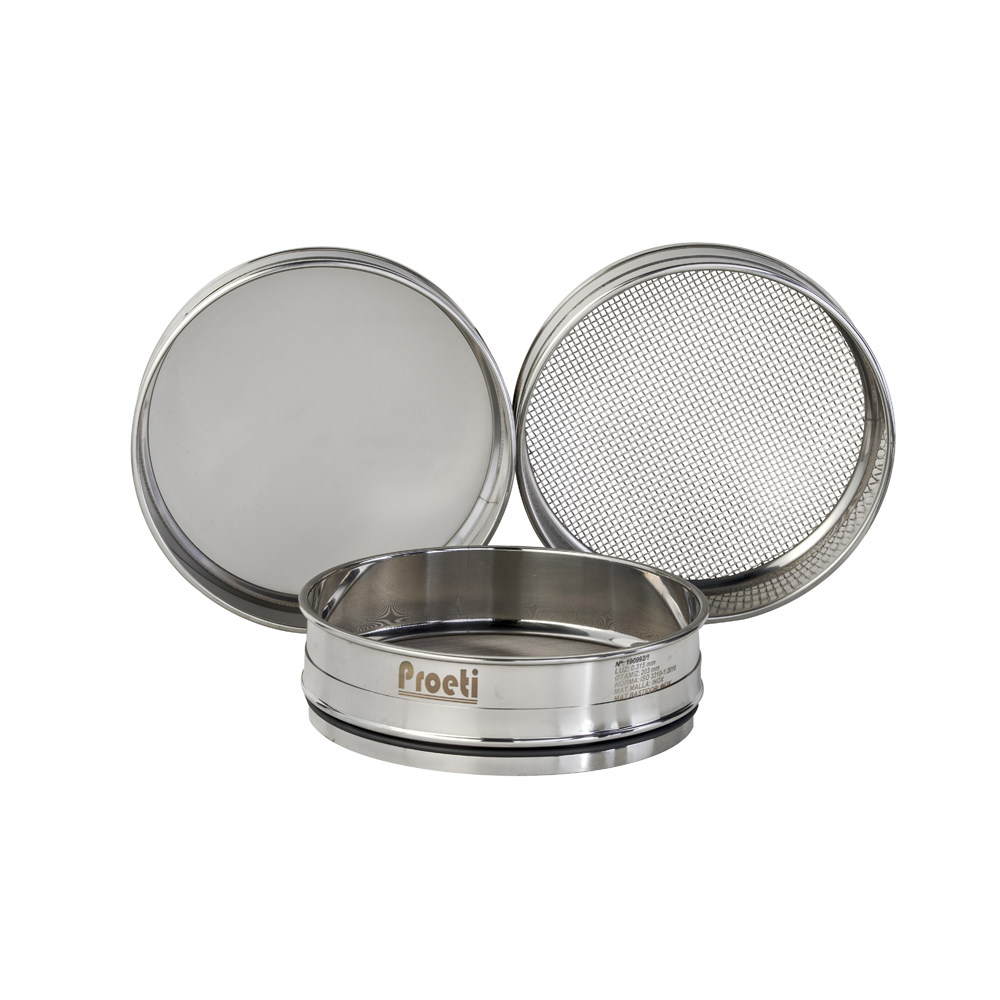
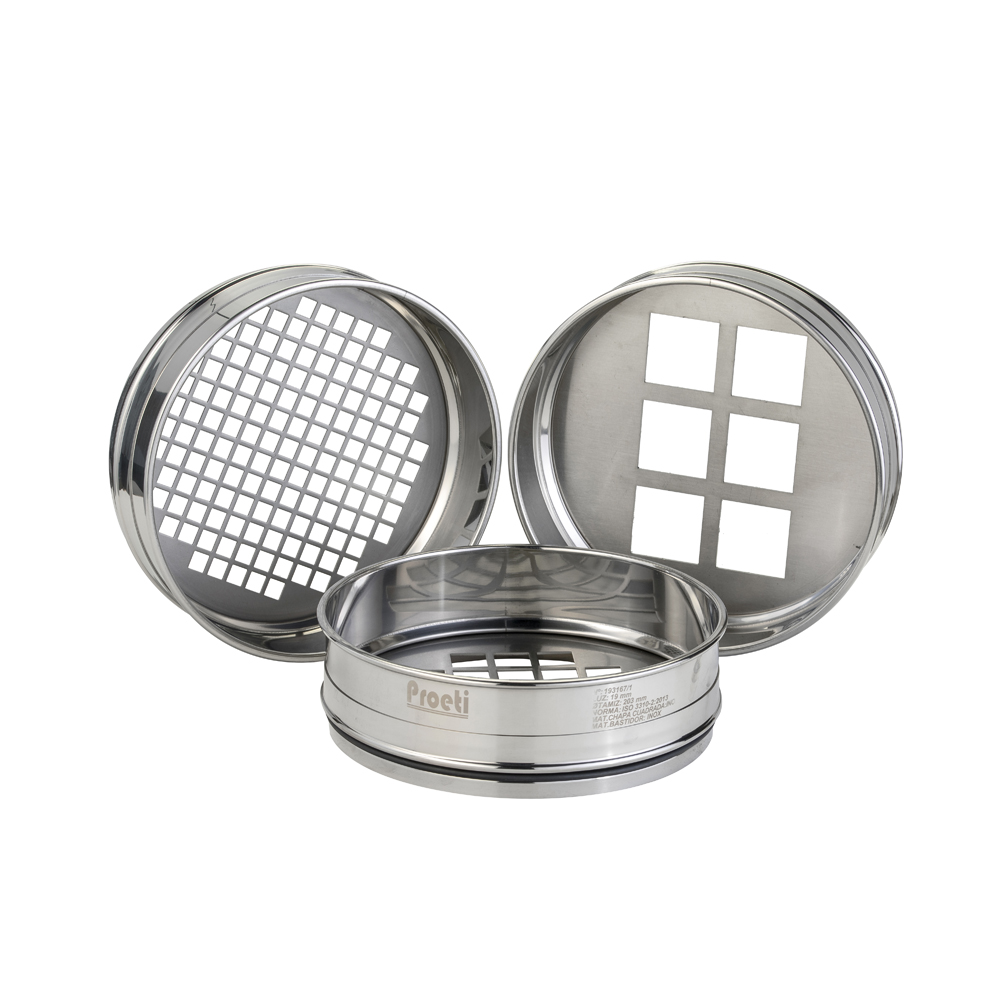
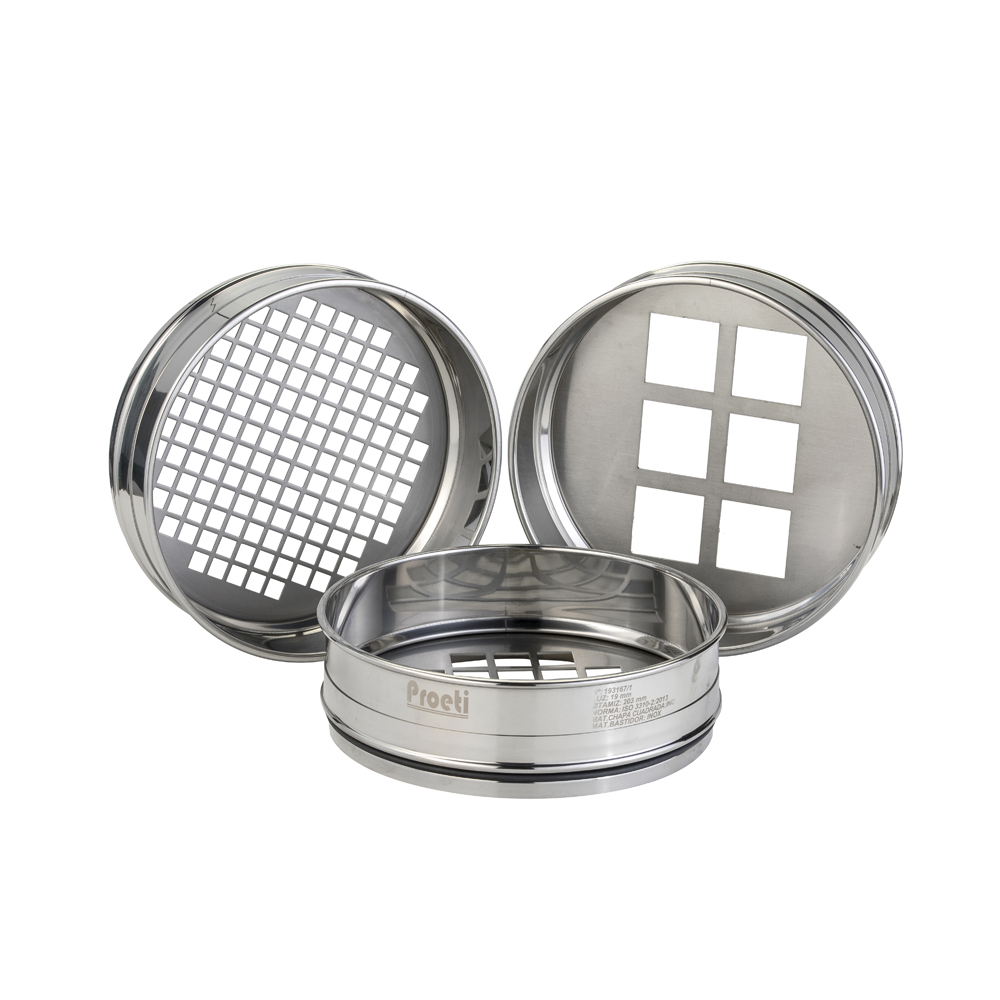
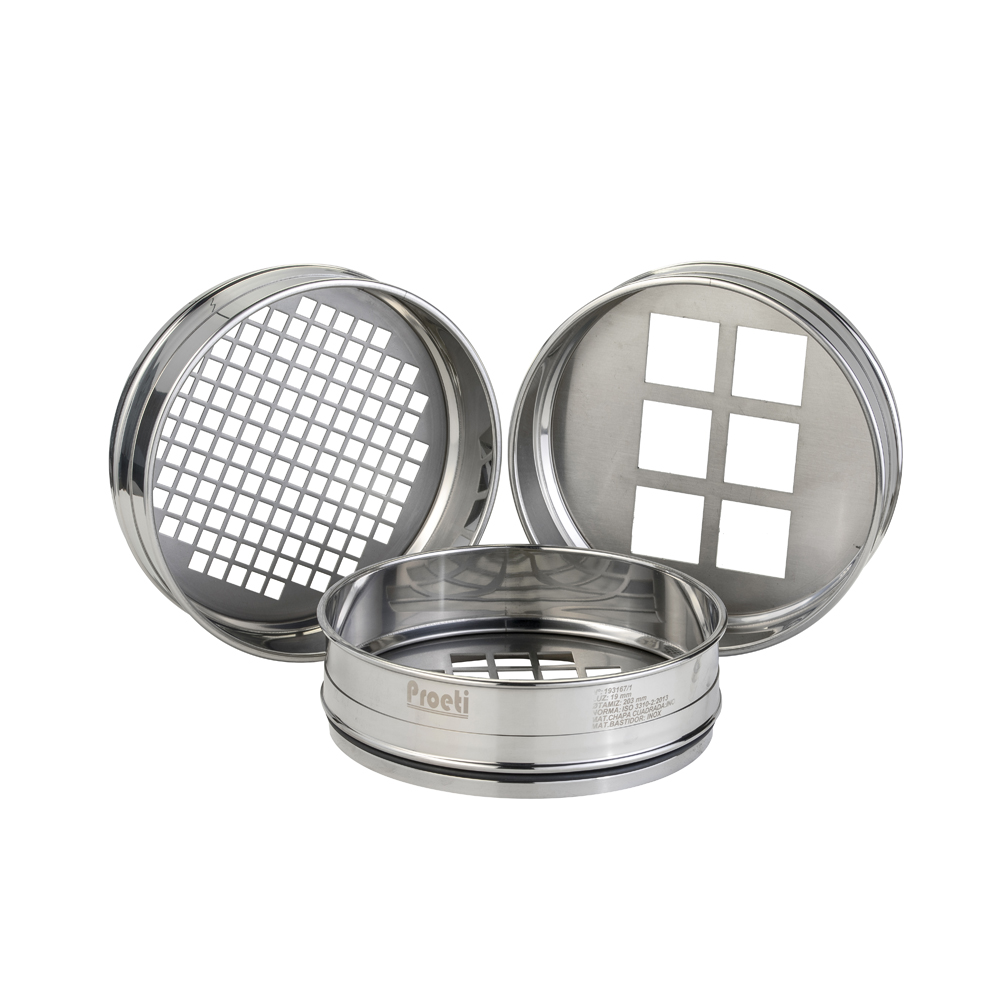
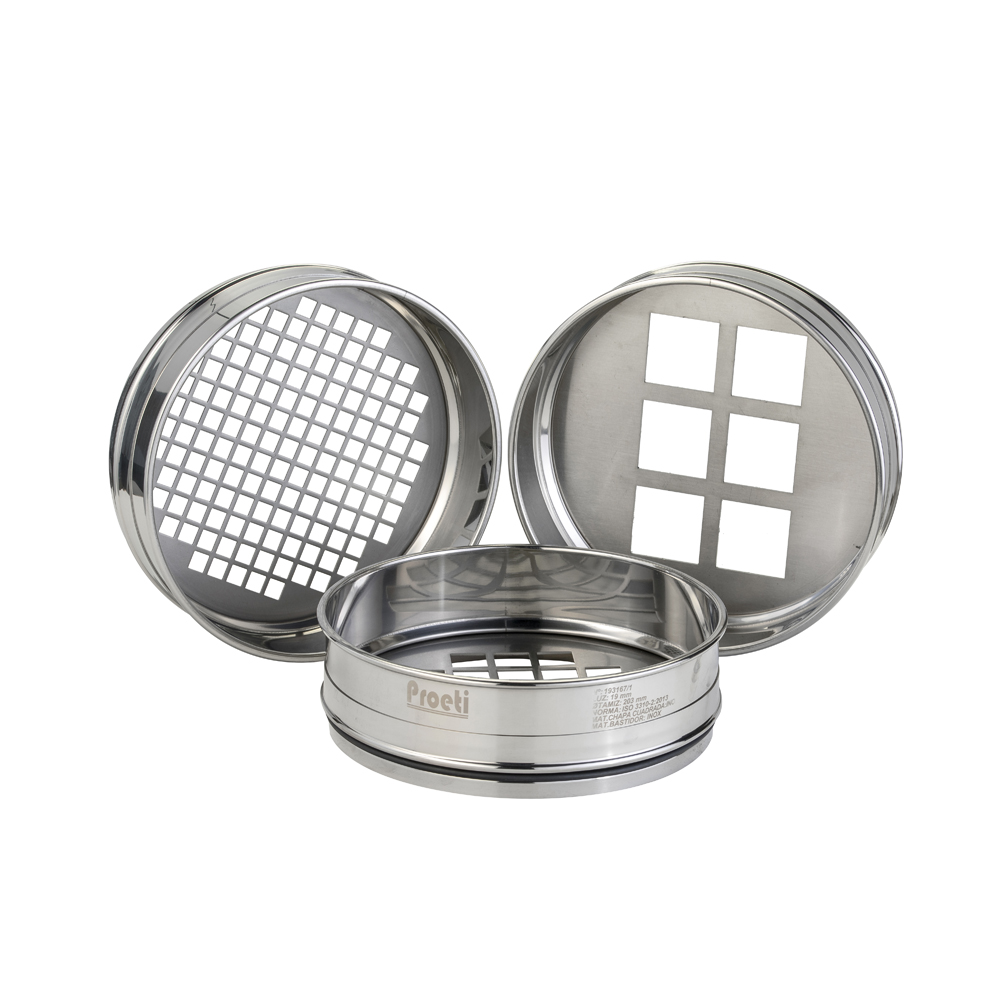
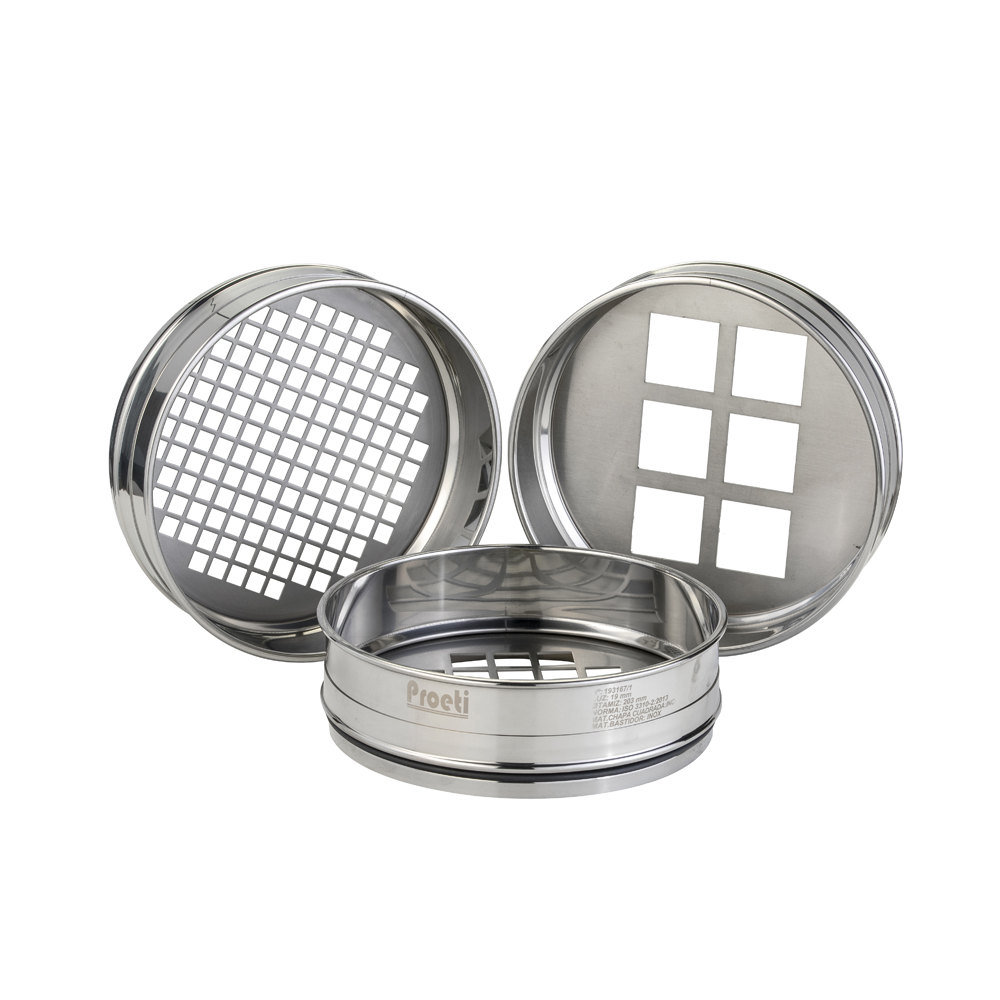
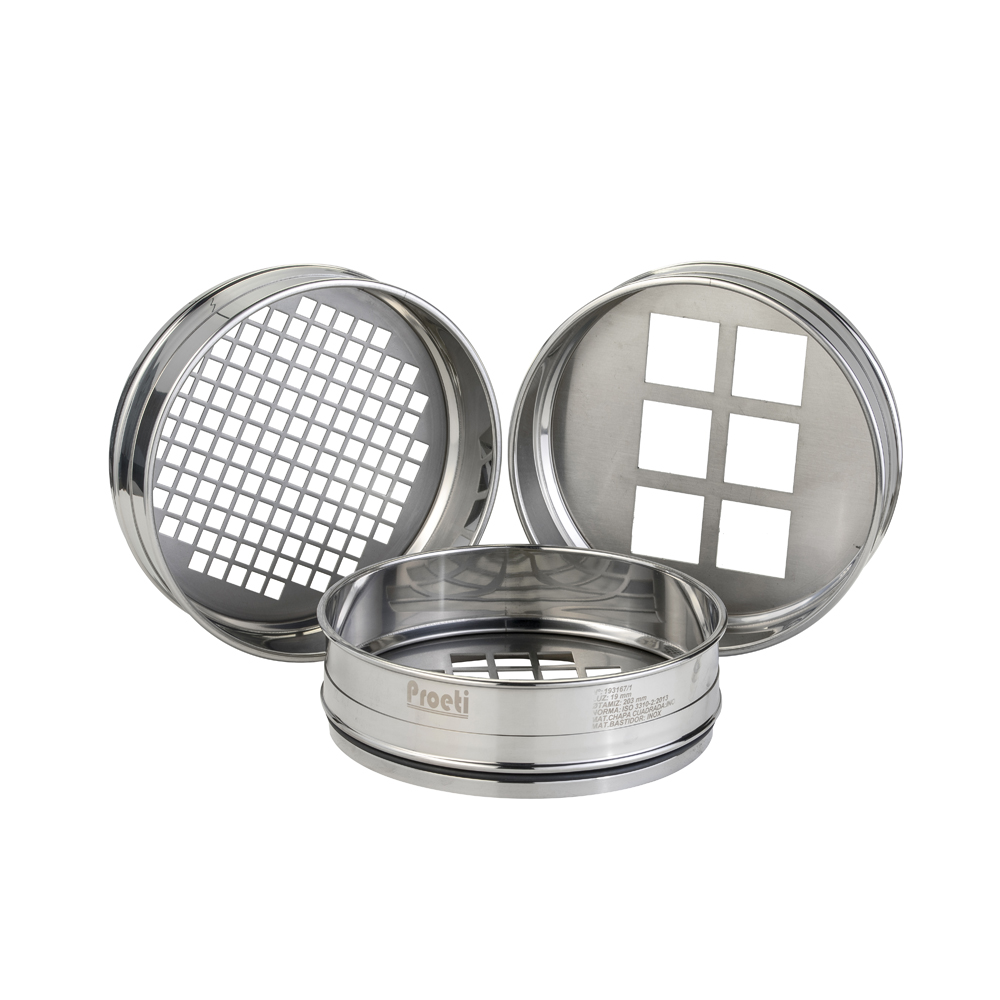
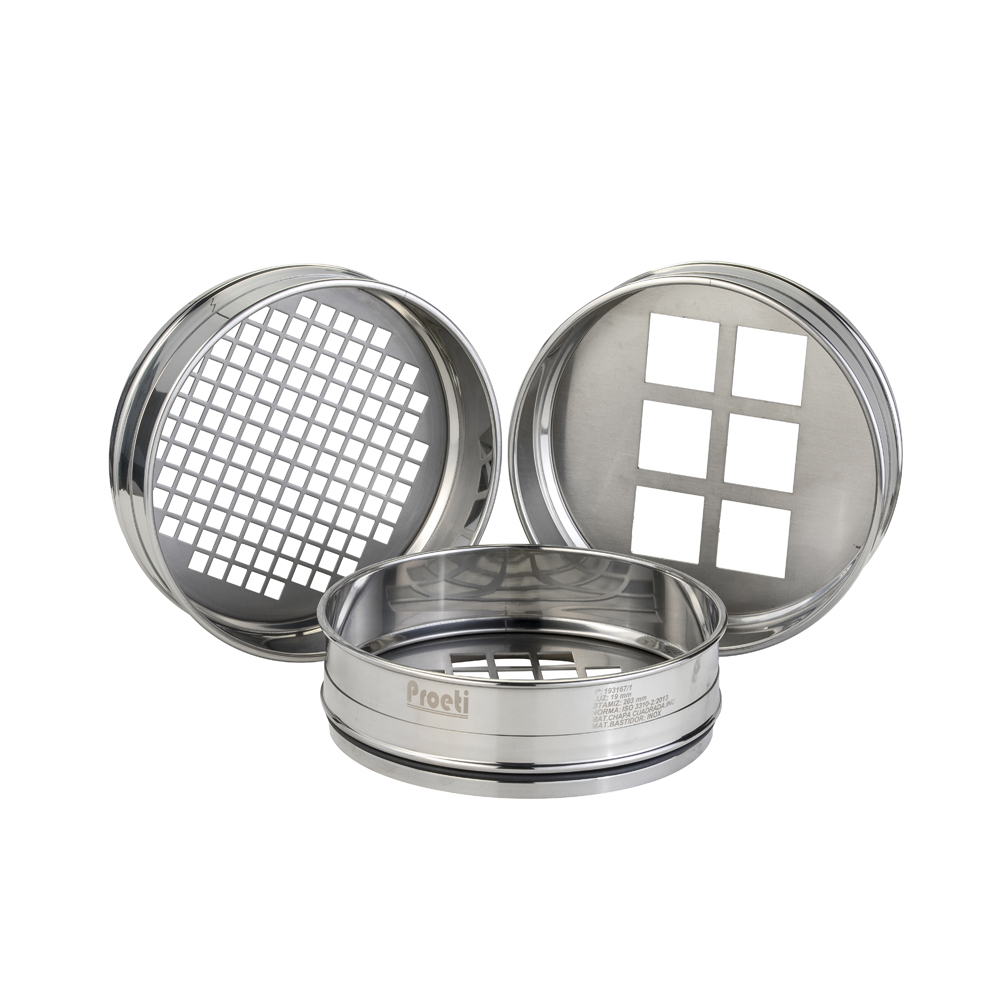
A particle size analysis needs the set of laboratory test sieves your standard specifies, a sieve shaker and a sample splitter to reduce the sample. We supply stainless steel wire mesh sieves (apertures from 0.020 to 4 mm) and perforated plate sieves (4 to 125 mm), from 200 to 400 mm in diameter and in 8 and 12 inches. Tell us your standard and ask us for the complete set.
It depends on the standard, the material and the amount of sample:
| If you work with… | You need |
|---|---|
| European standards (EN 933-1 and 933-2) | Sieves of 200, 250, 300, 315 or 400 mm: perforated plate from 4 mm and wire mesh below that |
| ASTM standards (ASTM C136; ASTM E11 sieves) | 8″ (203 mm) or 12″ (305 mm) sieves, with ASTM numbering (No. 4, No. 200…) |
| Sands, fines, filler and soils | Stainless steel wire mesh sieves, from 0.020 to 4 mm (ISO 3310-1) |
| Gravels and coarse aggregates | Perforated plate sieves, from 4 to 125 mm (ISO 3310-2) |
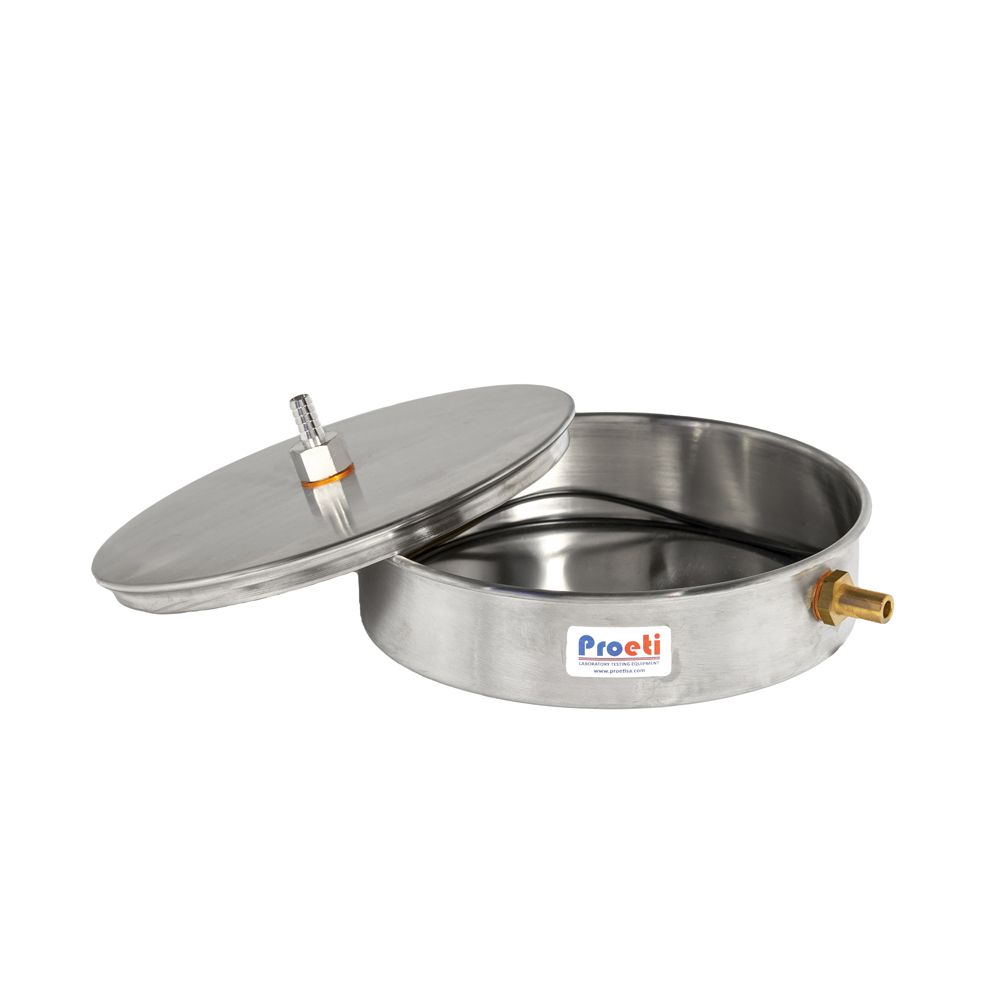
| Washing out the fines | 200 mm wet-washing sieve, with 0.063 or 0.074 mm mesh, with its lid and receiver |
| Large samples or coarse aggregate | Diameters from 300 to 400 mm, which take more material without being overloaded |
A sieve stack holds the sieves the standard calls for, plus the lid and receiver. Tell us the standard and we will put together the complete set.
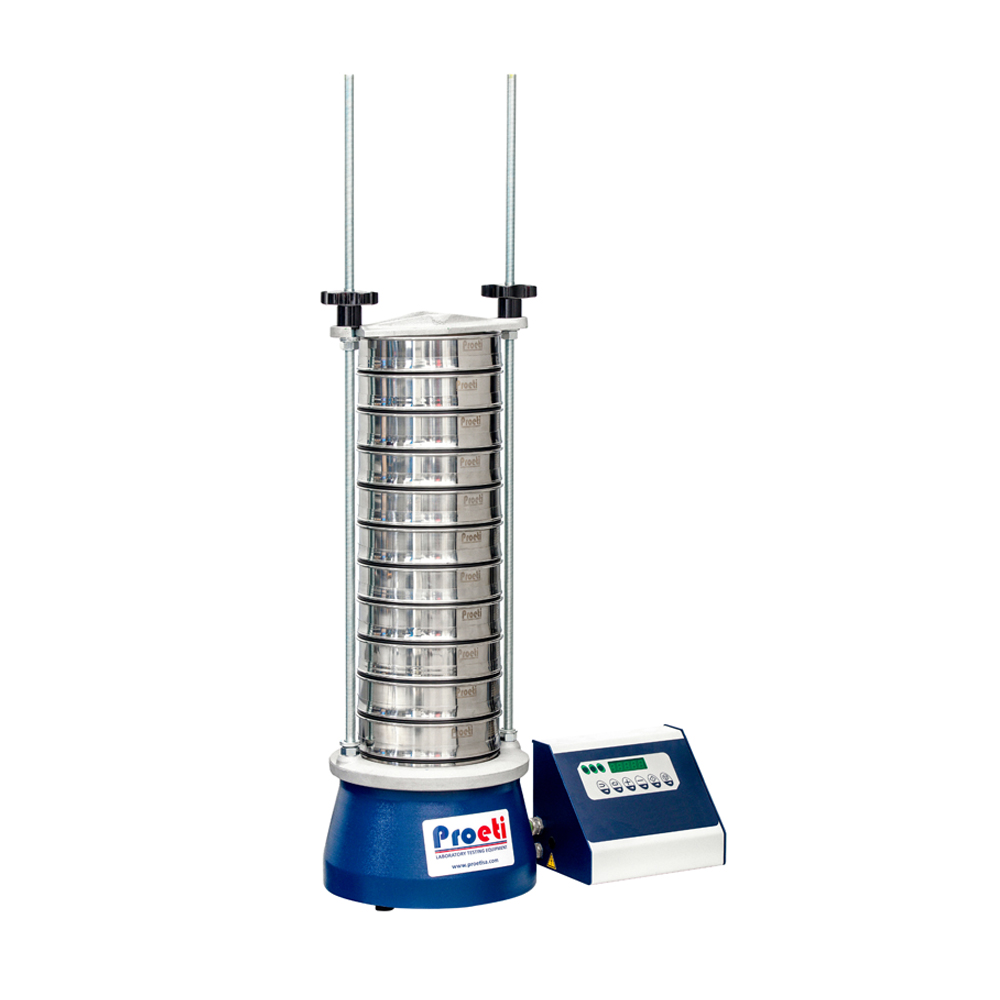
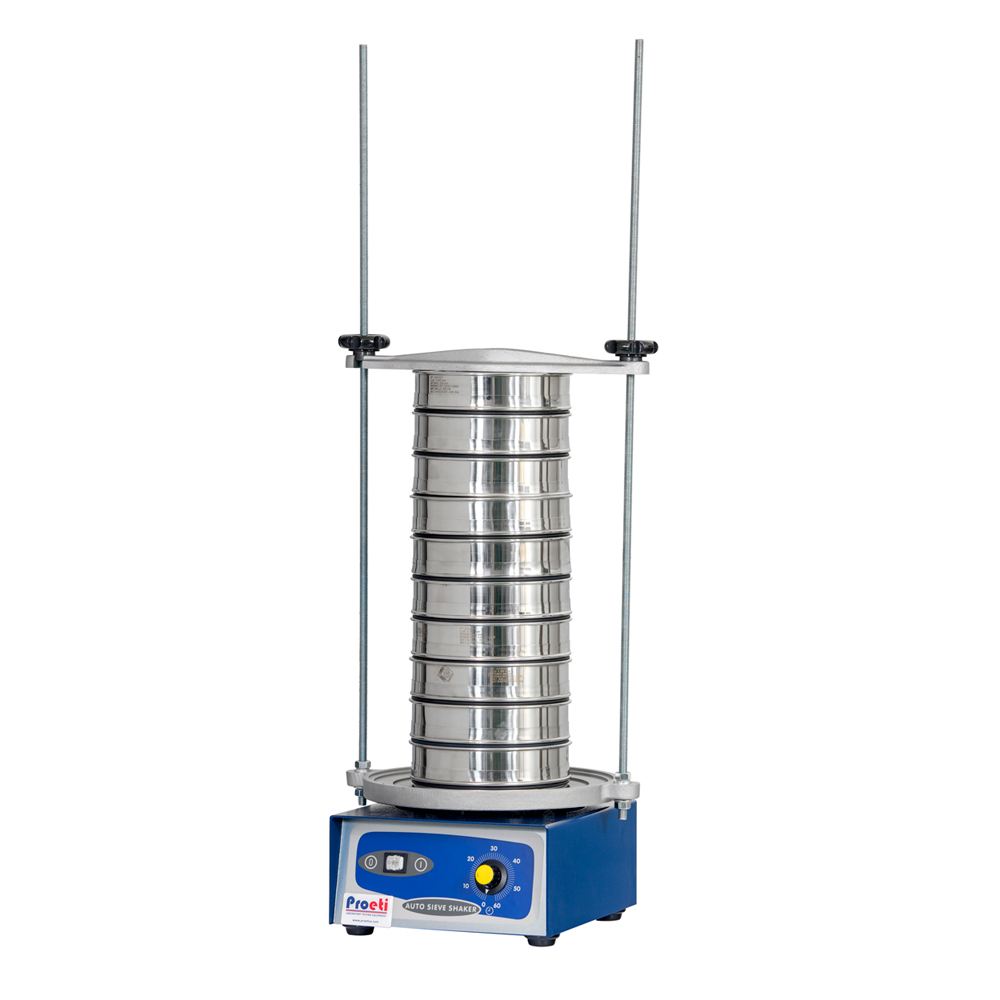
| Electromagnetic sieve shaker | Motor-operated sieve shaker | |
|---|---|---|
| Motion | Three-way: vertical, lateral and rotary | Electric motor |
| Capacity | Up to 10 sieves | Up to 8 sieves of 200 mm or 7 of 300 mm, with lid and receiver |
| Best for | Continuous, intensive use with high precision | Occasional use; it is more economical |
| Power | 450-750 W | 110 W, with a 0 to 60 minute timer |
| Wet sieving | Yes | Yes |
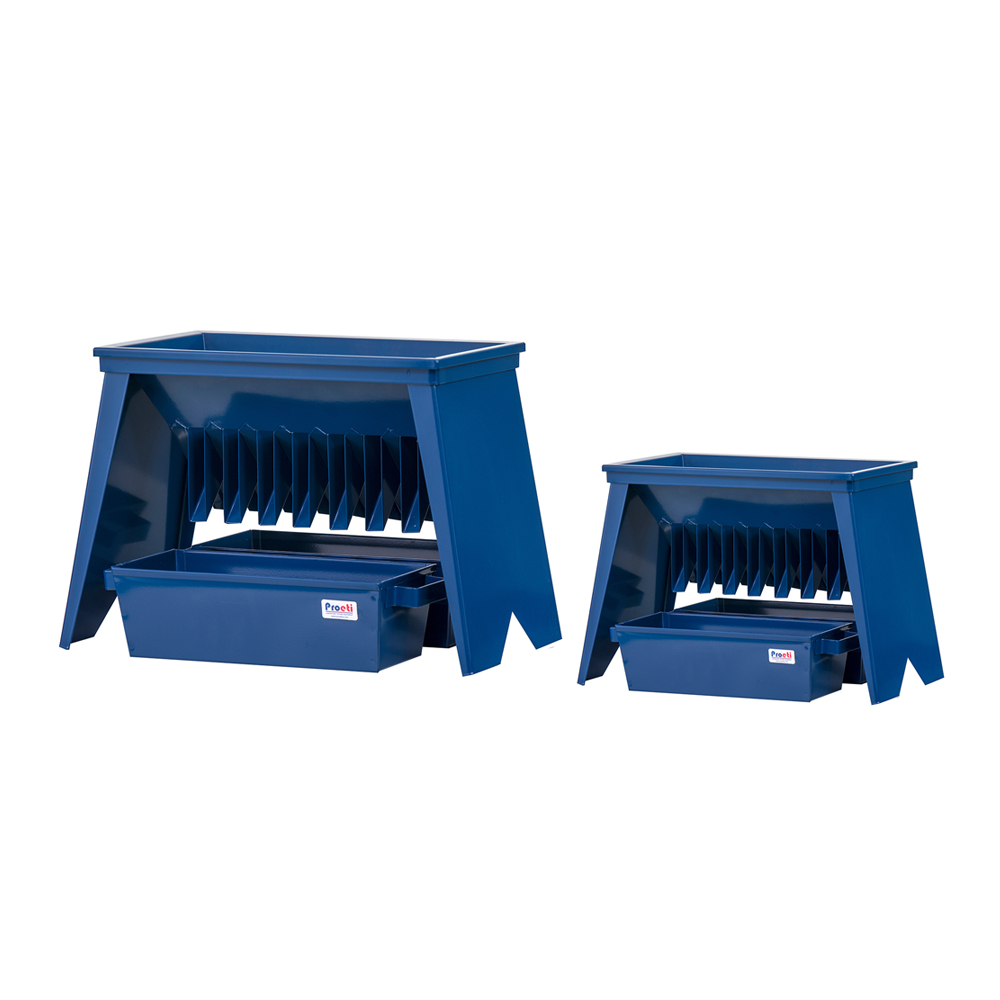
Both comply with EN 932-5. Product pages: electromagnetic sieve shaker and motor-operated sieve shaker. To reduce the sample before sieving, the sample splitter (EN 932-2, ASTM C702) is made of painted sheet steel and comes with two receivers.
To get a price, click Budget on each product page and send one request with everything you need. If you would rather talk to us, write to us or call +34 916 28 29 40.
It gives the proportion of particles of each size in an aggregate or a soil. The grading curve is used to check whether the aggregate falls within the envelope its standard requires, to adjust the mix design of concrete or bituminous mixtures, and to classify the soil in a geotechnical investigation.
Under EN 933-1: the sample is reduced with the splitter, dried in an oven at 110 ± 5 °C, washed over the 0.063 mm sieve, dried again and sieved through the stack, from the largest aperture to the smallest. The mass retained on each sieve gives the percentage passing, from which the grading curve is plotted.
Woven wire mesh, for small apertures (ISO 3310-1 and ASTM E11), and perforated plate, which EN 933-2 recommends from 4 mm upwards (ISO 3310-2). The frame diameter also varies, from 200 to 400 mm in the European series and 8 and 12 inches in the American one, and there are sieves with special receivers and lids for washing the sample.
European sieves are named by their aperture in millimetres; ASTM sieves by mesh number up to the 4.75 mm sieve: No. 4 = 4.75 mm, No. 10 = 2.00 mm, No. 40 = 0.425 mm, No. 200 = 0.075 mm. Fines are separated on the 0.063 mm sieve in European standards and on the No. 200 in American ones, so one series cannot replace the other.
Dry sieving is enough for a clean aggregate. If the particles have dust or clay stuck to them, they are first washed over the 0.063 mm sieve (wet sieving) and then dry-sieved: EN 933-1 requires this so that the fines content is not distorted.
After sieving come the geometric properties tests. All the equipment is in aggregates and rocks.