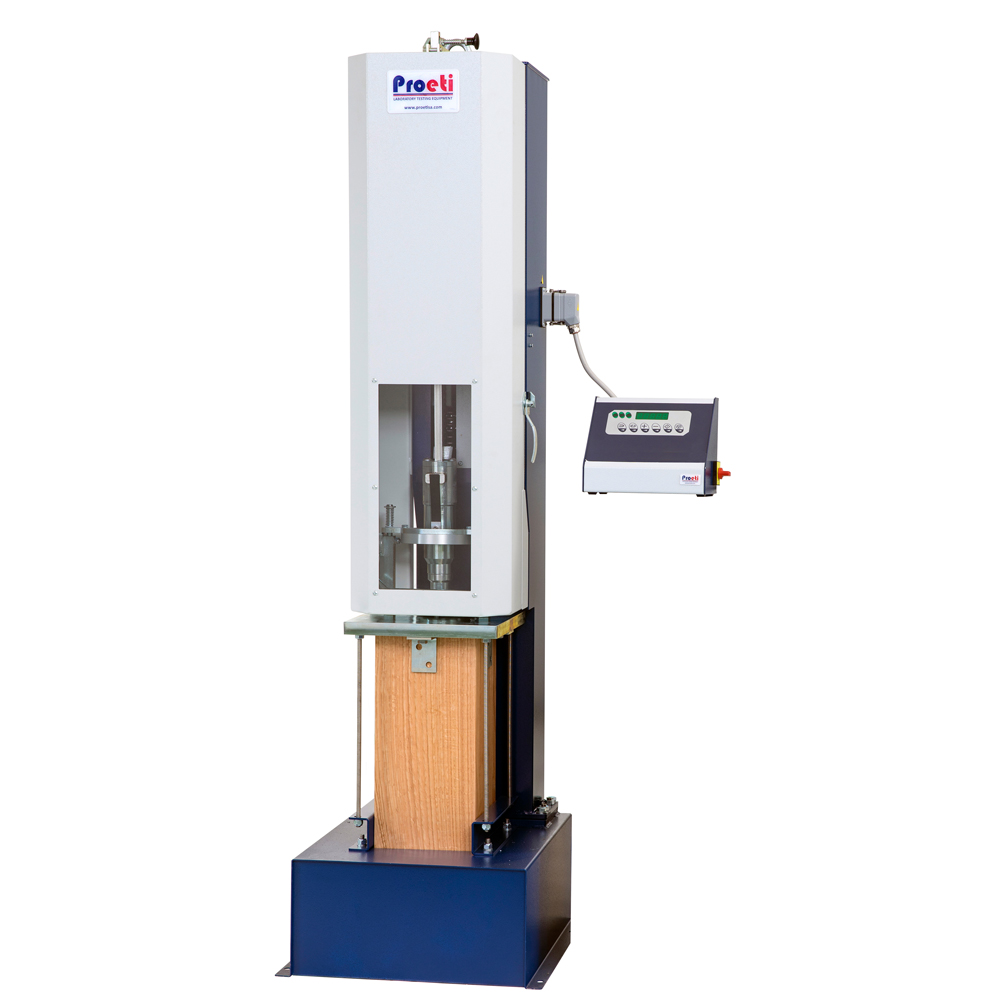
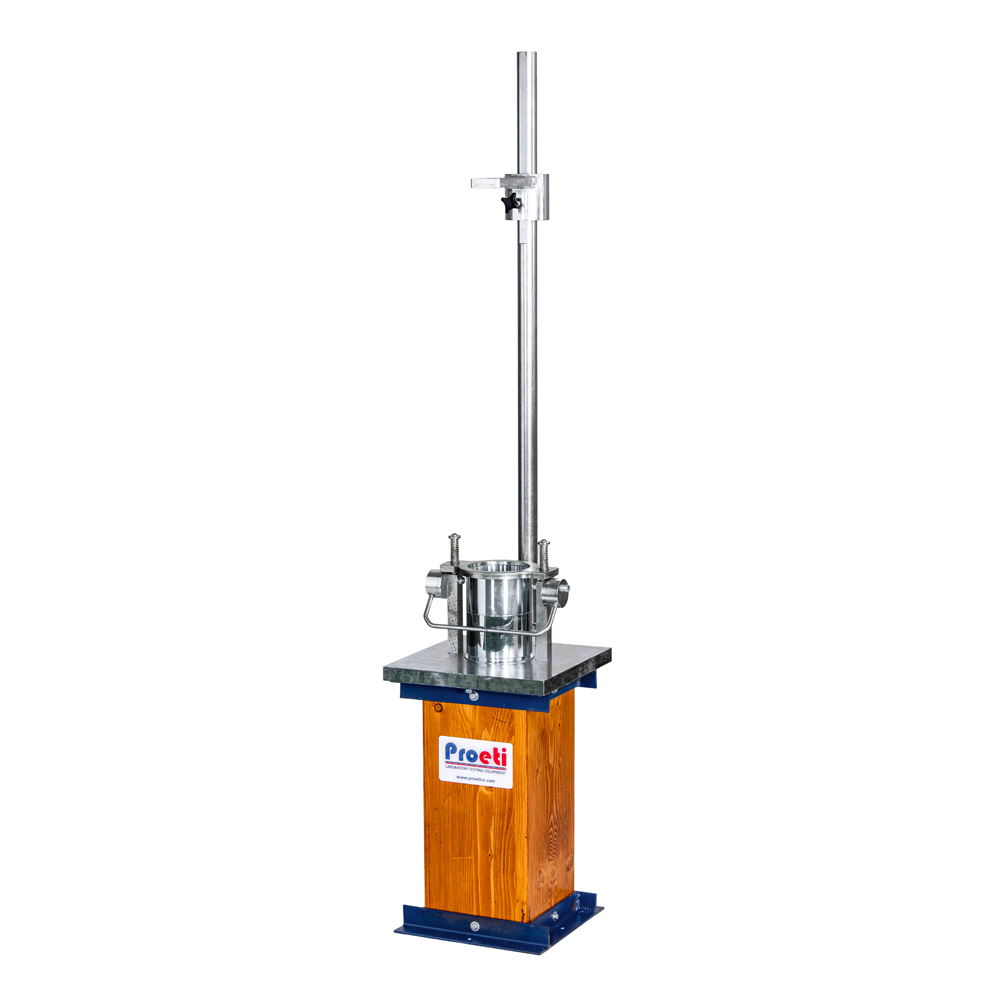
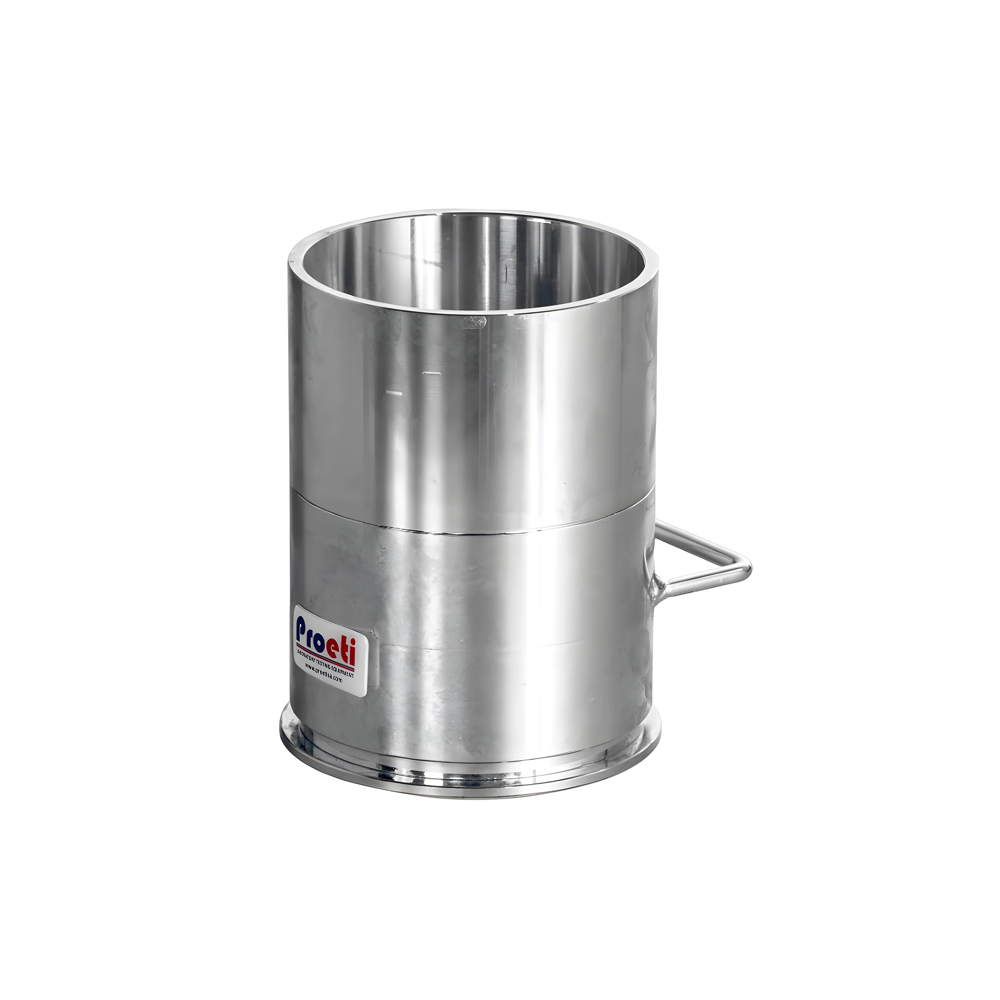
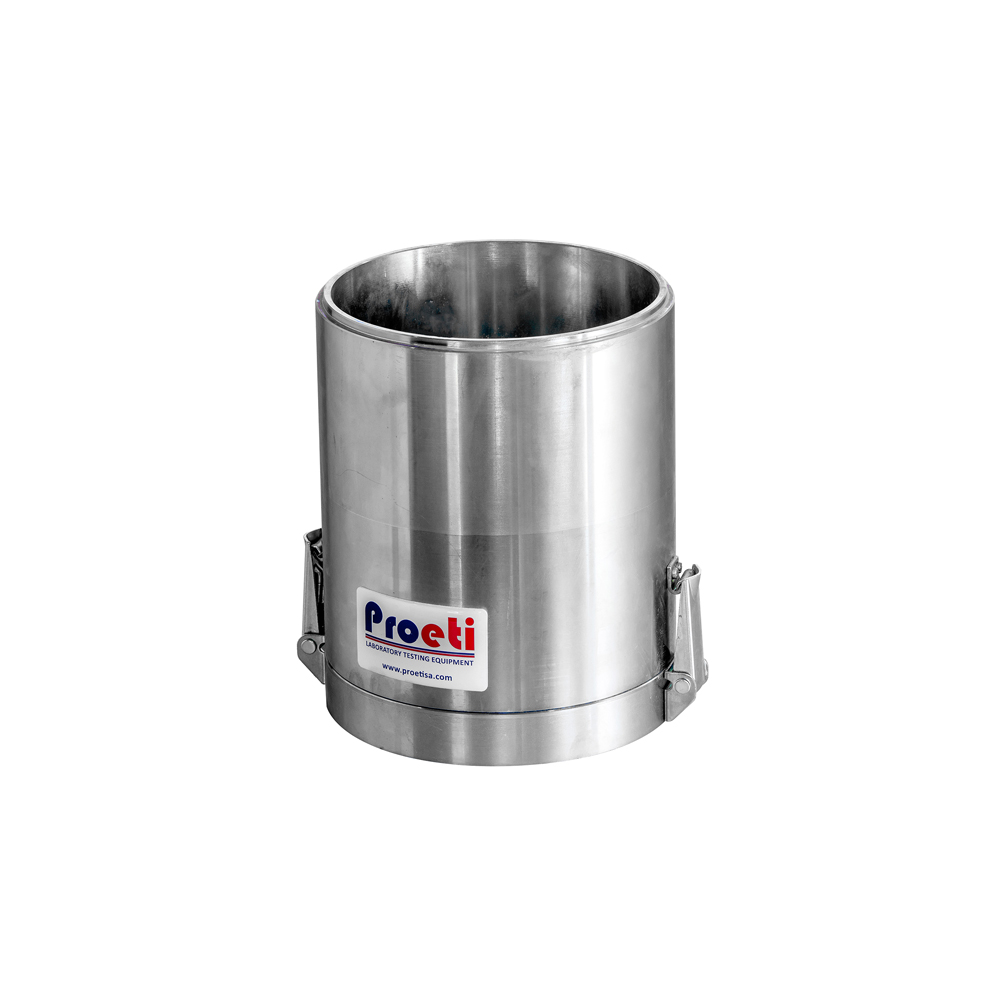
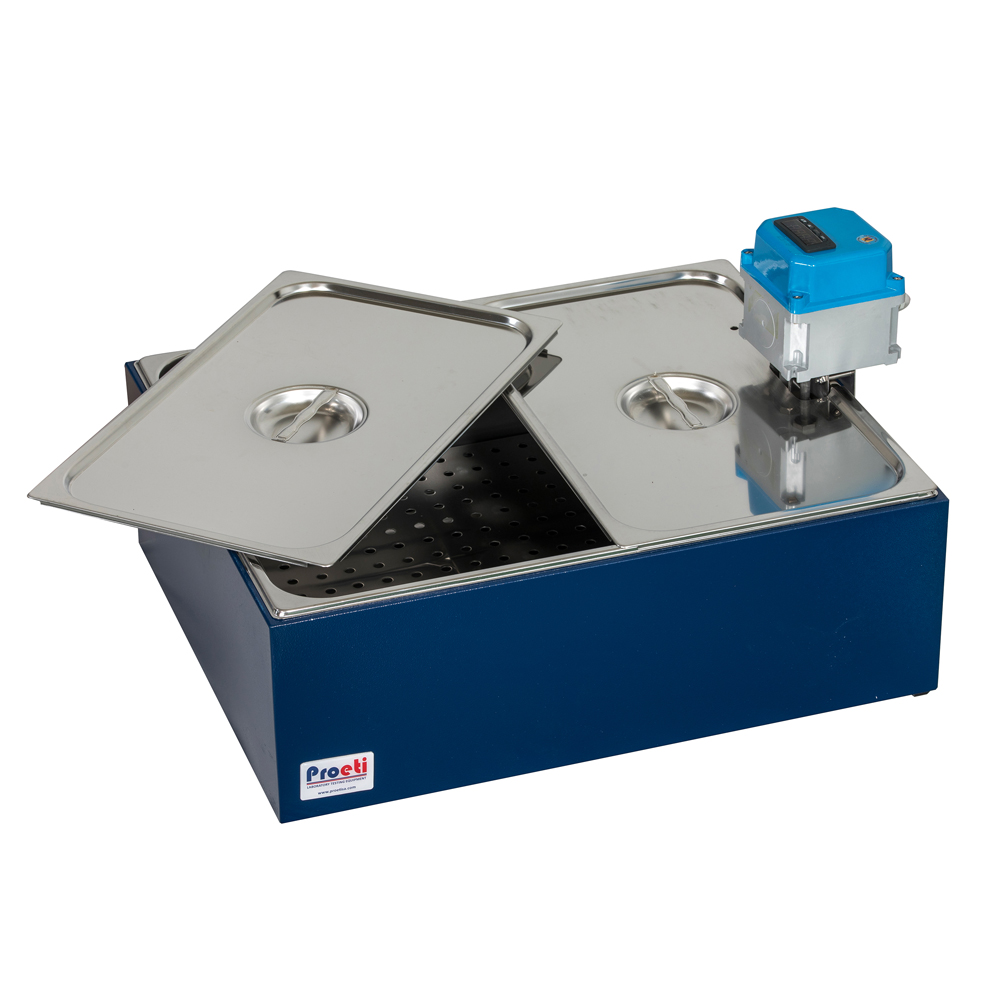
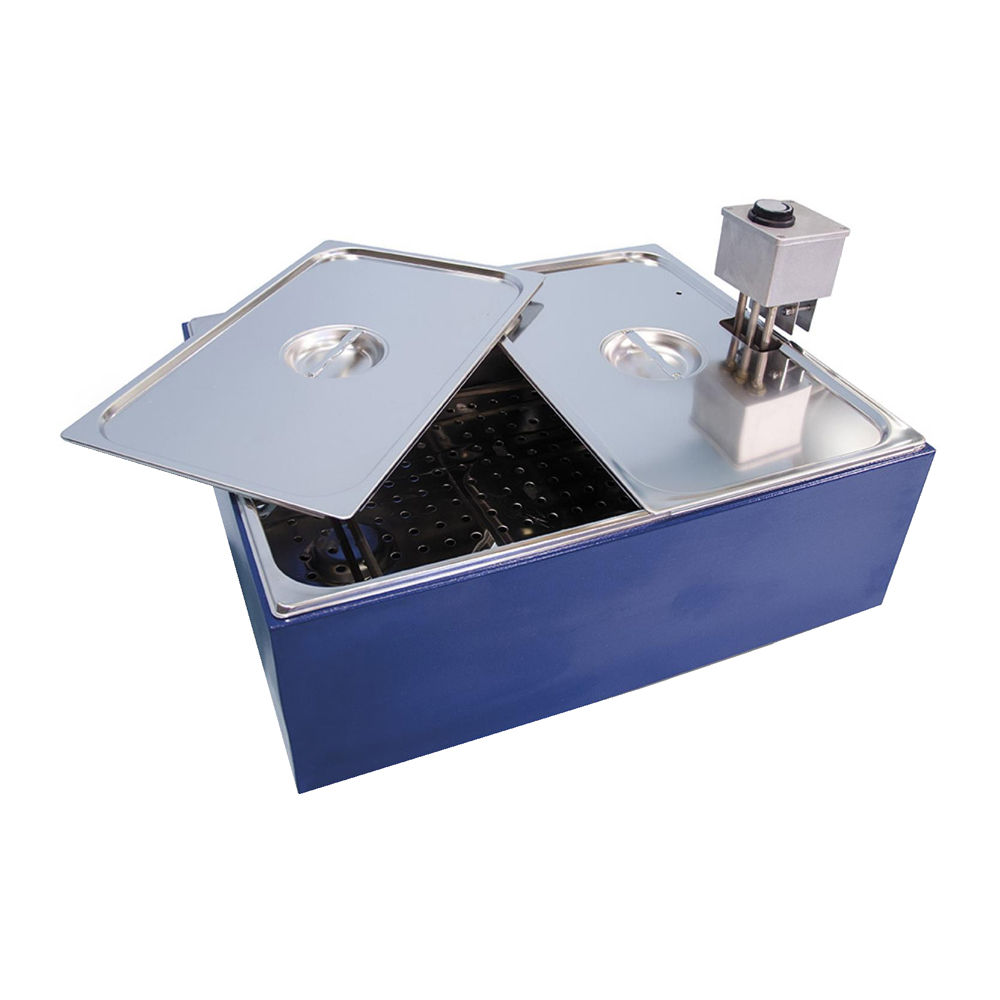
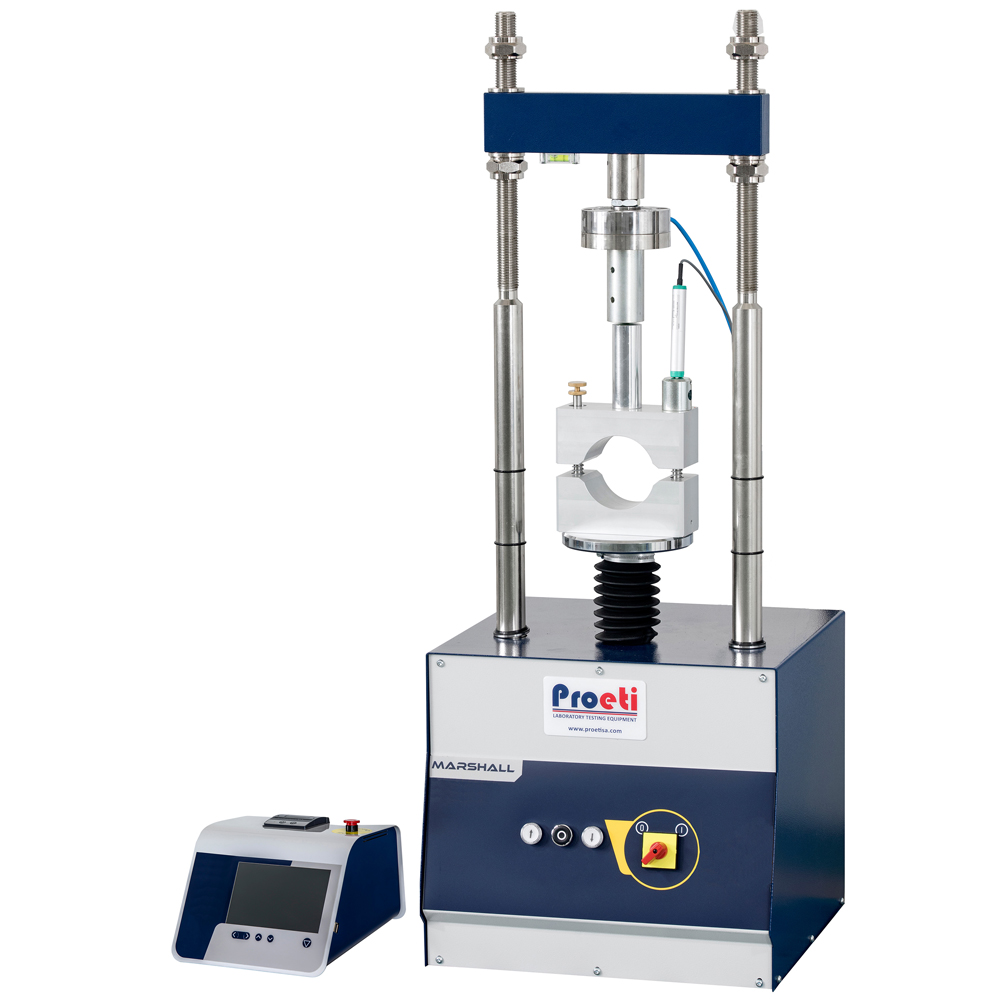
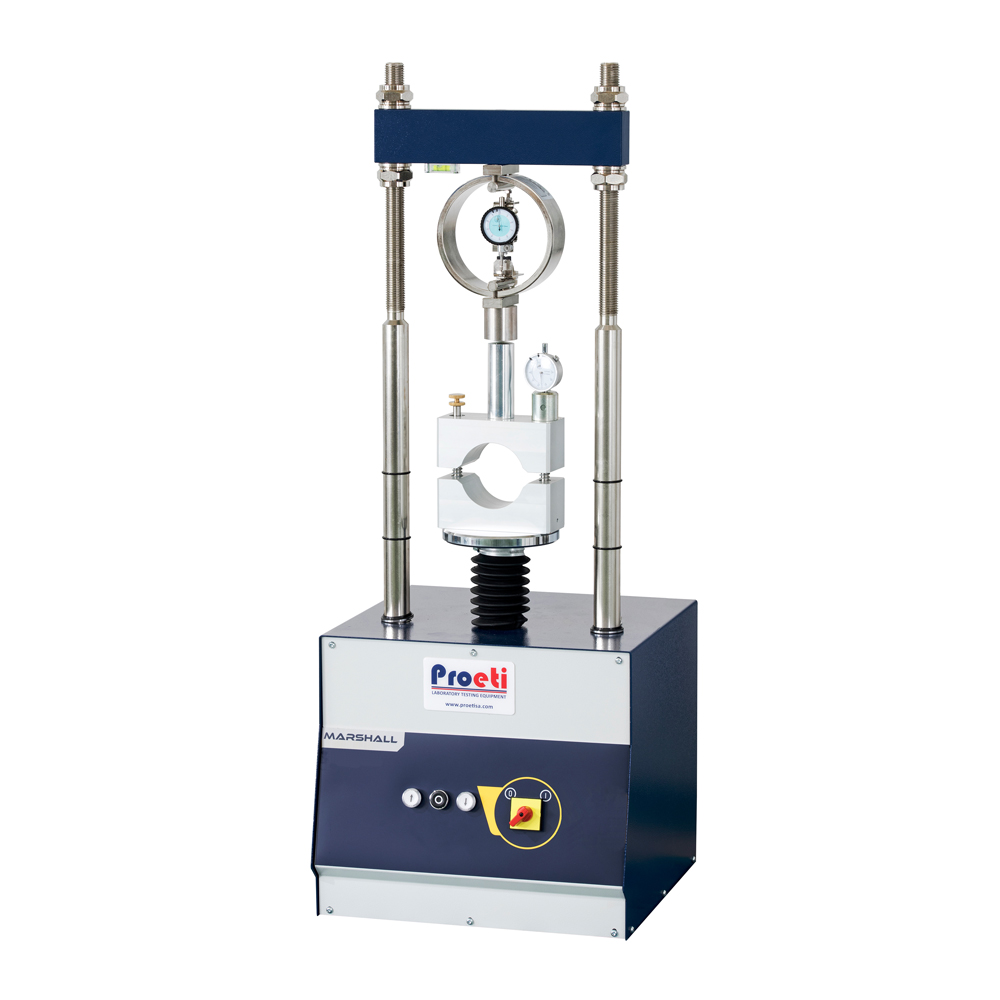
Compact the specimen, heat it in water at 60 °C and break it in the press: those are the three steps of the Marshall test, and this is the Marshall test equipment for each one. Manual and automatic Marshall compactors, 4″ moulds, thermostatic water baths and Marshall presses with analogue or digital readout, to EN 12697 and ASTM D6926 and D6927. If you are setting up the complete test, we will put the whole set together for you.
| Step | Equipment | Standard |
|---|---|---|
| 1. Mould the specimen | 4″ Marshall mould with collar and base plate | EN 12697-30 |
| 2. Compact | Manual Marshall compactor or automatic: 4,535 g hammer dropped from 457 mm | EN 12697-30, ASTM D6926 |
| 3. Condition | Marshall water bath at 60 ± 1 °C, for 20 specimens | EN 12697-34, ASTM D6927 |
| 4. Break | Digital Marshall press (50 kN load cell) or analogue (30 kN proving ring), at 50.8 mm/min | EN 12697-34, ASTM D6927 |
The same section includes the PRD mould, for the refusal density of mixtures (EN 12697-32), and the Duriez mould, for the French compression test after immersion (NF P98-251-1).
| Manual | Automatic | |
|---|---|---|
| How it strikes | The operator lifts and releases the hammer | Motor-driven; stops by itself at the set number of blows |
| Repeatability | Depends on the operator | Same height and rate for every blow: 50 blows per minute |
| Safety | Wooden pedestal with guide | Safety door that stops the machine when opened |
| Best for | A few specimens or teaching | Control laboratories with many specimens |
The digital press measures stability and flow at the same time and stores the data; the analogue one has a proving ring and a dial gauge. Both are supplied with a Marshall breaking head and an ENAC calibration certificate.
To get a price, click Budget on each product page and send one request with everything you need. If you would rather talk to us, write to us or call +34 916 28 29 40.
To design and control hot mix asphalt: it measures the load a specimen withstands before failing and how much it deforms. Specimens with different bitumen contents are used to choose the optimum, and on site it is checked that the mixture produced keeps giving similar values.
Cylindrical specimens 101.6 mm in diameter are compacted with a set number of blows per face (35, 50 or 75, depending on the traffic). They are kept in water at 60 °C and broken in the press, which loads them along a generatrix at 50.8 mm/min. Their density is measured beforehand to calculate the air voids.
Stability is the maximum load the specimen withstands, in kN. Flow is how much it has shortened at that moment, in mm. Their ratio, the Marshall quotient, gives an idea of the stiffness of the mixture: high if it is stiff, low if it deforms easily.
Marshall compacts by impact and is based on stability and flow. Superpave uses a gyratory compactor, which kneads the mixture in a way closer to a roller, and designs by the air voids at a number of gyrations, together with performance-based binder tests.
To find out beforehand how much bitumen the mixture contains, see mixture analysis.